Abstract
Pregnancy-associated breast cancer (PABC), defined as breast cancer diagnosed during pregnancy or within 12 months after delivery, is uncommon, and survival data from sub-Saharan Africa are scarce. The objective of this study was to describe the clinical, obstetric and tumor characteristics of women with PABC managed in Abidjan, Côte d'Ivoire, to estimate their overall survival and to explore factors associated with mortality. We conducted a retrospective cohort study of women with histologically confirmed PABC diagnosed between 2012 and 2025 and managed in the Departments of Obstetrics-Gynecology and Medical Oncology of Treichville University Hospital. Overall survival was estimated with the Kaplan–Meier method and compared between groups with the log-rank test; unadjusted hazard ratios (HR) were obtained by univariable Cox regression. Thirty-one women were analyzed. Mean age at diagnosis was 37.0 ± 4.2 years, and 29 women (93.5%) were diagnosed during pregnancy. Presentation was late: 74.2% had T3–T4 tumors, all had nodal involvement and 25.8% had distant metastases at diagnosis. Thirteen women died; the median follow-up was 4.8 years. Overall survival was 89.9% at 1 year, 70.8% at 3 years and 54.3% at 5 years. All deaths occurred in women with T4 tumors. Metastatic disease at diagnosis was strongly associated with death (HR 21.4; 95% confidence interval [CI] 4.4–105.1; p < 0.001), as were a consultation delay of 6 months or more (HR 5.0; 95% CI 1.6–15.6; p = 0.006) and the triple-negative phenotype (HR 6.3; 95% CI 1.5–25.7; p = 0.011). After adjustment for metastatic status, consultation delay was no longer associated with survival (HR 0.90; 95% CI 0.18–4.48), and the effect of the triple-negative phenotype could not be separated from that of metastatic disease. In this Ivorian cohort, PABC was mostly diagnosed at an advanced stage, and survival was determined mainly by stage at diagnosis. Earlier detection of breast abnormalities during antenatal care and faster access to multidisciplinary treatment are needed in low-resource settings.
|
Published in
|
Journal of Gynecology and Obstetrics (Volume 14, Issue 6)
|
|
DOI
|
10.11648/j.jgo.20261406.12
|
|
Page(s)
|
122-130 |
|
Creative Commons
|

This is an Open Access article, distributed under the terms of the Creative Commons Attribution 4.0 International License (http://creativecommons.org/licenses/by/4.0/), which permits unrestricted use, distribution and reproduction in any medium or format, provided the original work is properly cited.
|
|
Copyright
|
Copyright © The Author(s), 2026. Published by Science Publishing Group
|
Keywords
Pregnancy-Associated Breast Cancer, Pregnancy, Overall Survival, Prognosis, Metastasis, Sub-Saharan Africa, Côte d'Ivoire
1. Introduction
Pregnancy-associated breast cancer (PABC) refers to breast cancer diagnosed during pregnancy or in the first year after delivery
| [1] | Amant, F., Loibl, S., Neven, P., Van Calsteren, K. Breast cancer in pregnancy. Lancet. 2012, 379(9815), 570-579.
https://doi.org/10.1016/S0140-6736(11)61092-1 |
| [2] | Loibl, S., Schmidt, A., Gentilini, O., Kaufman, B., Kuhl, C., Denkert, C., et al. Breast cancer diagnosed during pregnancy: adapting recent advances in breast cancer care for pregnant patients. JAMA Oncology. 2015, 1(8), 1145-1153.
https://doi.org/10.1001/jamaoncol.2015.2413 |
[1, 2]
. It is estimated to complicate about 1 in 3,000 to 1 in 10,000 pregnancies and is the most common malignancy diagnosed in pregnant women
. Its frequency is expected to increase as childbearing is increasingly postponed in many countries
| [1] | Amant, F., Loibl, S., Neven, P., Van Calsteren, K. Breast cancer in pregnancy. Lancet. 2012, 379(9815), 570-579.
https://doi.org/10.1016/S0140-6736(11)61092-1 |
| [2] | Loibl, S., Schmidt, A., Gentilini, O., Kaufman, B., Kuhl, C., Denkert, C., et al. Breast cancer diagnosed during pregnancy: adapting recent advances in breast cancer care for pregnant patients. JAMA Oncology. 2015, 1(8), 1145-1153.
https://doi.org/10.1001/jamaoncol.2015.2413 |
[1, 2]
.
Pregnancy complicates both diagnosis and treatment. Physiological enlargement and increased density of the breast can mask a palpable mass and make imaging more difficult to interpret, which often delays diagnosis
| [2] | Loibl, S., Schmidt, A., Gentilini, O., Kaufman, B., Kuhl, C., Denkert, C., et al. Breast cancer diagnosed during pregnancy: adapting recent advances in breast cancer care for pregnant patients. JAMA Oncology. 2015, 1(8), 1145-1153.
https://doi.org/10.1001/jamaoncol.2015.2413 |
| [3] | Yang, W. T., Dryden, M. J., Gwyn, K., Whitman, G. J., Theriault, R. Imaging of breast cancer diagnosed and treated with chemotherapy during pregnancy. Radiology. 2006, 239(1), 52-60. https://doi.org/10.1148/radiol.2391050083 |
[2, 3]
. Pregnancy and post-partum involution are also accompanied by hormonal, immune and stromal changes that may favor tumor progression, although their independent effect on prognosis is still debated
| [4] | Schedin, P. Pregnancy-associated breast cancer and metastasis. Nature Reviews Cancer. 2006, 6(4), 281-291.
https://doi.org/10.1038/nrc1839 |
| [5] | Callihan, E. B., Gao, D., Jindal, S., Lyons, T. R., Manthey, E., Edgerton, S., et al. Postpartum diagnosis demonstrates a high risk for metastasis and merits an expanded definition of pregnancy-associated breast cancer. Breast Cancer Research and Treatment. 2013, 138(2), 549-559.
https://doi.org/10.1007/s10549-013-2437-x |
[4, 5]
.
In addition, each therapeutic decision must weigh the urgency of maternal treatment against the risks for the fetus. This maternal-fetal dilemma has important ethical and psychological consequences for the patient and her family
| [6] | Oduncu, F. S., Kimmig, R., Hepp, H., Emmerich, B. Cancer in pregnancy: maternal-fetal conflict. Journal of Cancer Research and Clinical Oncology. 2003, 129(3), 133-146.
https://doi.org/10.1007/s00432-002-0406-6 |
[6]
.
The prognostic impact of pregnancy itself remains controversial. Meta-analyses have reported higher mortality in PABC, particularly when the cancer is diagnosed after delivery
| [7] | Azim, H. A. Jr., Santoro, L., Russell-Edu, W., Pentheroudakis, G., Pavlidis, N., Peccatori, F. A. Prognosis of pregnancy-associated breast cancer: a meta-analysis of 30 studies. Cancer Treatment Reviews. 2012, 38(7), 834-842.
https://doi.org/10.1016/j.ctrv.2012.06.004 |
| [8] | Shao, C., Yu, Z., Xiao, J., Liu, L., Hong, F., Zhang, Y., et al. Prognosis of pregnancy-associated breast cancer: a meta-analysis. BMC Cancer. 2020, 20(1), 746.
https://doi.org/10.1186/s12885-020-07248-8 |
[7, 8]
, whereas an international study comparing pregnant women with non-pregnant women of similar age and stage found comparable survival when standard treatment was given
| [9] | Amant, F., von Minckwitz, G., Han, S. N., Bontenbal, M., Ring, A. E., Giermek, J., et al. Prognosis of women with primary breast cancer diagnosed during pregnancy: results from an international collaborative study. Journal of Clinical Oncology. 2013, 31(20), 2532-2539. https://doi.org/10.1200/JCO.2012.45.6335 |
[9]
. In low-resource settings, late presentation and limited access to diagnosis and treatment lead to a higher proportion of locally advanced and metastatic breast cancer
| [10] | Vanderpuye, V., Grover, S., Hammad, N., Simonds, H., Olopade, O. I., Stefan, D. C. An update on the management of breast cancer in Africa. Infectious Agents and Cancer. 2017, 12, 13. https://doi.org/10.1186/s13027-017-0124-y |
[10]
, which may outweigh any specific effect of pregnancy.
Data on PABC from sub-Saharan Africa are scarce, and survival analyses are rarely reported. The objectives of this study were to describe the clinical, obstetric and tumor characteristics and the management of women with PABC treated at Treichville University Hospital in Abidjan, Côte d'Ivoire, to estimate their overall survival, and to explore factors associated with mortality.
2. Materials and Methods
2.1. Study Design and Setting
We conducted a retrospective cohort study in the Department of Obstetrics-Gynecology and the Department of Medical Oncology of Treichville University Hospital, Abidjan, Côte d'Ivoire. Women diagnosed between June 2012 and June 2025 were included, and vital status was updated until 12 December 2025, which was the closing date of follow-up.
2.2. Study Population
Cases were identified from the medical records and registers of both departments. All women with histologically confirmed breast cancer diagnosed during pregnancy or within 12 months after delivery during the study period were included, without exclusion (n = 31). Women who were lost to follow-up were not excluded; they were censored at the date of last contact.
2.3. Variables
Variables collected included: age at diagnosis; consultation delay (interval between the first symptom reported by the patient and the first medical consultation), reason for consultation, and timing of onset (pregnancy or postpartum); tumor characteristics (tumor, node, metastasis (TNM) classification, metastases at diagnosis, histological type, hormone receptor and human epidermal growth factor receptor 2 (HER2) status, triple-negative phenotype, defined as the absence of estrogen receptor, progesterone receptor and HER2 overexpression (TNBC)); pregnancy outcome; treatment modalities (chemotherapy, surgery, radiotherapy, endocrine therapy); and outcome data (date of death or last contact).
2.4. Statistical Analysis
Continuous variables are presented as mean ± standard deviation (SD) and range, and categorical variables as numbers and percentages. Women who died during follow-up were compared with those alive at last contact using Fisher's exact test for categorical variables, because of small expected counts, and Student's t test for age. Missing values were not imputed; analyses involving a variable with missing data were restricted to patients with available data.
Overall survival (OS) was measured from the date of histological diagnosis to the date of death from any cause. Women alive at the closing date, or lost to follow-up, were censored at their date of last contact. Median follow-up was estimated with the reverse Kaplan–Meier method. OS was estimated using the Kaplan–Meier method and reported at 1, 3 and 5 years with 95% CI (log-log transformation); survival curves were compared using the log-rank test.
Univariable Cox proportional hazards regression was used to estimate unadjusted hazard ratios (HR) with 95% confidence intervals (CI) for age (continuous), metastatic status (M1 vs M0), consultation delay (≥ 6 vs < 6 months) and triple-negative phenotype (TNBC vs other subtypes). With only 13 deaths, a full multivariable model would have been unreliable (fewer than 10 events per variable). We therefore only fitted exploratory two-variable models in which each factor was adjusted for metastatic status, the strongest prognostic factor. The proportional hazards assumption was checked graphically. A two-sided p value < 0.05 was considered statistically significant. Analyses were performed with Python 3 (SciPy and statsmodels libraries).
2.5. Ethical Considerations
This study was conducted in accordance with the Declaration of Helsinki. Data were collected retrospectively from medical records and hospital registers and were anonymized before analysis; no identifying information was recorded. Given the retrospective design and the use of anonymized data, individual informed consent was not required.
3. Results
3.1. Patient Selection and General Characteristics
All 31 women with histologically confirmed PABC managed during the study period were included in the analysis. Mean age at diagnosis was 37.0 ± 4.2 years (range 25–46), and 25 women (80.6%) were younger than 40 years. Consultation occurred within 6 months of the first symptom in 23 women (74.2%), after 6 to 12 months in 2 (6.5%) and after more than 1 year in 5 (16.1%); the delay was not documented in one case. The presenting complaint was a breast lump in 19 cases (61.3%), skin changes in 8 (25.8%) and a breast ulceration in 4 (12.9%) (
Table 1).
3.2. Obstetric Characteristics and Outcomes
Breast cancer was diagnosed during pregnancy in 29 women (93.5%) and after delivery in 2 (6.5%). Among the 29 women diagnosed during pregnancy, diagnosis occurred in the first trimester in 8, the second trimester in 15 and the third trimester in 6. A therapeutic termination of pregnancy (TOP) was performed in 7 women (22.6%), all diagnosed in the first trimester (7 of 8 first-trimester diagnoses). Sixteen women (51.6%) delivered by cesarean section and 5 (16.1%) vaginally; the pregnancy outcome was inconsistently documented in one woman diagnosed in the second trimester. The mode and timing of delivery were decided by the multidisciplinary team, taking into account gestational age and the need to start or continue cancer treatment.
3.3. Tumor Characteristics and Treatment
Disease was locally advanced in most cases: 23 tumors (74.2%) were T3 or T4, and all 31 women had nodal involvement (N1, 77.4%; N2, 22.6%). Eight women (25.8%) had distant metastases at diagnosis. Histology showed invasive carcinoma of no special type in 29 cases (93.5%) and breast sarcoma in 2 (6.5%). Among the 27 tumors with available immunohistochemistry, 12 were luminal, 6 HER2-enriched and 9 triple-negative (29.0% of the cohort). Twenty-nine women (93.5%) received chemotherapy: neoadjuvant chemotherapy (four cycles of fluorouracil, epirubicin 100 mg/m² and cyclophosphamide [FEC100] followed by four cycles of docetaxel) in the 21 women without metastases who were treated, and palliative chemotherapy in the 8 women with metastases. Breast surgery was performed in 23 women (74.2%): mastectomy in 15 (48.4%) and breast-conserving surgery in 8 (25.8%); none of the 7 women who did not undergo surgery was free of metastases. Radiotherapy was given to 12 women (38.7%) and endocrine therapy to 10 (32.3%) (
Table 1).
Table 1. Clinical, obstetric, and tumor characteristics of the cohort (n = 31).
Variable | n | % |
Age at diagnosis | | |
< 40 years | 25 | 80.6 |
≥ 40 years | 6 | 19.4 |
Time to consultation | | |
< 6 months | 23 | 74.2 |
6–12 months | 2 | 6.5 |
> 1 year | 5 | 16.1 |
Reason for consultation | | |
Breast lump | 19 | 61.3 |
Skin changes | 8 | 25.8 |
Breast ulceration | 4 | 12.9 |
Timing of diagnosis | | |
During pregnancy | 29 | 93.5 |
Postpartum | 2 | 6.5 |
— 1st trimester | 8 | 25.8 |
— 2nd trimester | 15 | 48.4 |
— 3rd trimester | 6 | 19.4 |
Pregnancy outcome | | |
Therapeutic termination of pregnancy | 7 | 22.6 |
Vaginal delivery | 5 | 16.1 |
Cesarean section | 16 | 51.6 |
Tumor size (T) | | |
T1 | 2 | 6.5 |
T2 | 6 | 19.4 |
T3 | 9 | 29.0 |
T4 | 14 | 45.2 |
Nodal status (N) | | |
N0 | 0 | 0 |
N1 | 24 | 77.4 |
N2 | 7 | 22.6 |
Metastatic status | | |
M0 | 23 | 74.2 |
M1 | 8 | 25.8 |
Immunohistochemical profile | | |
Triple-negative (TNBC) | 9 | 29.0 |
Other subtypes (luminal 12, HER2-enriched 6) | 18 | 58.1 |
Treatment | | |
Chemotherapy | 29 | 93.5 |
Breast surgery (total) | 23 | 74.2 |
— Conservative | 8 | 25.8 |
— Radical | 15 | 48.4 |
Radiotherapy | 12 | 38.7 |
Endocrine therapy | 10 | 32.3 |
Percentages are calculated on the 31 patients. Trimester rows are subgroups of the 29 diagnoses made during pregnancy. Not documented: consultation delay, 1; pregnancy outcome, 1 (2 further women were diagnosed after delivery); immunohistochemistry, 4; chemotherapy, 1; surgery, 1; radiotherapy, 7. TNBC: triple-negative breast cancer; HER2: human epidermal growth factor receptor 2.
3.4. Comparison of Deceased and Surviving Patients
All 8 women with metastases at diagnosis died, compared with 5 of the 23 women without metastases (p < 0.001). All 13 deaths occurred in women with T4 tumors; only 1 of the 14 women with a T4 tumor was alive at last contact, whereas none of the 17 women with T1–T3 tumors died (p < 0.001). Among women with available data, a consultation delay of 6 months or more was more frequent among those who died (6/12 vs 1/18; p = 0.009), as was the triple-negative phenotype (6/9 vs 3/18; p = 0.026); the 4 women with undocumented immunohistochemistry all died. All surviving women had undergone breast surgery, compared with 5 of the 12 deceased women with available data (p < 0.001). Mean age did not differ between groups (p = 0.35) (
Table 2). Because surgery was not performed in metastatic disease, the association between surgery and survival reflects stage and should not be interpreted as a treatment effect.
Table 2. Comparison of patients who died and patients alive at last contact (n = 31).
Variable | Alive (n = 18) | Deceased (n = 13) | p value |
Age (years, mean ± SD) | 37.6 ± 4.0 | 36.2 ± 4.5 | 0.35 |
Metastatic status | | | |
M0 | 18 (100%) | 5 (38.5%) | |
M1 | 0 (0%) | 8 (61.5%) | < 0.001 |
Tumor size | | | |
T1–T3 | 17 (94.4%) | 0 (0%) | |
T4 | 1 (5.6%) | 13 (100%) | < 0.001 |
Immunohistochemical profile (n = 27) | | | |
Other subtypes | 15 (83.3%) | 3 (33.3%) | |
Triple-negative | 3 (16.7%) | 6 (66.7%) | 0.026 |
Breast surgery (n = 30) | | | |
Yes | 18 (100%) | 5 (41.7%) | |
No | 0 (0%) | 7 (58.3%) | < 0.001 |
p values from Fisher's exact test (categorical variables) and Student's t test (age). Percentages are calculated on patients with available data. SD: standard deviation.
3.5. Survival Analysis
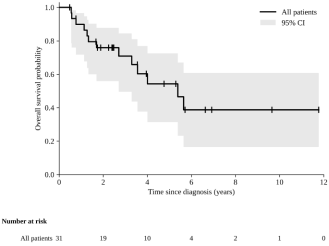
Thirteen deaths (41.9%) were recorded. The 18 surviving women were censored at their date of last contact; the median follow-up estimated by the reverse Kaplan–Meier method was 4.8 years (follow-up of censored women: median 3.0 years, range 0.5–11.8). Twelve of these 18 women had their last contact more than one year before the closing date and were therefore considered lost to follow-up. OS was 89.9% (95% CI 71.8–96.6) at 1 year, 70.8% (95% CI 49.5–84.5) at 3 years and 54.3% (95% CI 31.3–72.5) at 5 years, and median OS was 5.4 years (
Figure 1).
Figure 1. Kaplan–Meier estimate of overall survival in the whole cohort (n = 31). The shaded area represents the 95% confidence interval; vertical ticks indicate censored observations.
OS was significantly shorter in women who consulted 6 months or more after the first symptom than in those who consulted earlier (median OS 1.3 vs 5.6 years; 5-year OS 14.3% vs 71.8%; log-rank p = 0.003). OS was also shorter in women with triple-negative tumors than in those with other subtypes (log-rank p = 0.004, n = 27). No death occurred among women with T1–T3 tumors (log-rank p < 0.001 for T4 vs T1–T3).
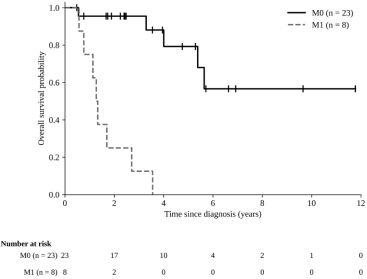
The largest difference was observed according to metastatic status: median OS was 1.3 years in women with metastases at diagnosis, none of whom survived beyond 4 years, whereas 5-year OS was 79.3% in women without metastases (log-rank p < 0.001) (
Figure 2).
Figure 2. Kaplan–Meier estimates of overall survival according to metastatic status at diagnosis (M0, n = 23; M1, n = 8); log-rank p < 0.001. Vertical ticks indicate censored observations.
3.6. Univariable Cox Regression Analysis
In univariable Cox regression, metastatic disease at diagnosis was associated with a markedly higher risk of death (HR 21.4; 95% CI 4.4–105.1; p < 0.001). A consultation delay of 6 months or more (HR 5.0; 95% CI 1.6–15.6; p = 0.006) and the triple-negative phenotype (HR 6.3; 95% CI 1.5–25.7; p = 0.011) were also associated with mortality, whereas age was not (HR 0.96 per year; 95% CI 0.87–1.07; p = 0.50) (
Table 3). A Cox model could not be estimated for tumor size, because no death occurred in women with T1–T3 tumors.
In an exploratory two-variable model adjusted for metastatic status, consultation delay was no longer associated with survival (HR 0.90; 95% CI 0.18–4.48; p = 0.90), whereas metastatic status remained strongly associated with death (HR 21.9; 95% CI 2.9–162.5; p = 0.003). The triple-negative phenotype could not be adjusted for metastatic status, because all 5 women with metastases and available immunohistochemistry had triple-negative tumors. The very wide CIs reflect the small number of events.
Table 3. Factors associated with overall survival: univariable Cox regression and log-rank test.
Variable | Unadjusted HR (95% CI) | p (Cox) | p (log-rank) |
Metastases (M1) | 21.4 (4.4–105.1) | < 0.001 | < 0.001 |
Delay ≥ 6 months (n = 30) | 5.0 (1.6–15.6) | 0.006 | 0.003 |
Triple-negative phenotype (n = 27) | 6.3 (1.5–25.7) | 0.011 | 0.004 |
Age (per year) | 0.96 (0.87–1.07) | 0.50 | NA |
HR: hazard ratio; CI: confidence interval; NA: not applicable (continuous variable). Tumor size (T4 vs T1–T3) is not shown because no death occurred in the T1–T3 group (log-rank p < 0.001). No full multivariable model was fitted because of the small number of events (n = 13).
4. Discussion
This retrospective cohort of 31 women with PABC managed in Abidjan shows three main findings. First, most patients were diagnosed at an advanced stage, with 74.2% T3–T4 tumors, nodal involvement in all cases and 25.8% distant metastases. Second, 5-year OS was 54.3%, which is lower than the survival reported in series from high-income countries
| [9] | Amant, F., von Minckwitz, G., Han, S. N., Bontenbal, M., Ring, A. E., Giermek, J., et al. Prognosis of women with primary breast cancer diagnosed during pregnancy: results from an international collaborative study. Journal of Clinical Oncology. 2013, 31(20), 2532-2539. https://doi.org/10.1200/JCO.2012.45.6335 |
| [11] | Johansson, A. L. V., Andersson, T. M. L., Hsieh, C. C., Cnattingius, S., Lambe, M. Increased mortality in women with breast cancer detected during pregnancy and different periods postpartum. Cancer Epidemiology, Biomarkers & Prevention. 2011, 20(9), 1865-1872.
https://doi.org/10.1158/1055-9965.EPI-11-0515 |
[9, 11]
. Third, survival was determined mainly by stage: all deaths occurred in women with T4 tumors, and metastatic disease at diagnosis was the factor most strongly associated with death.
The proportion of metastatic disease in our cohort is much higher than in series from high-income countries, where PABC is usually diagnosed at a non-metastatic stage
| [2] | Loibl, S., Schmidt, A., Gentilini, O., Kaufman, B., Kuhl, C., Denkert, C., et al. Breast cancer diagnosed during pregnancy: adapting recent advances in breast cancer care for pregnant patients. JAMA Oncology. 2015, 1(8), 1145-1153.
https://doi.org/10.1001/jamaoncol.2015.2413 |
| [9] | Amant, F., von Minckwitz, G., Han, S. N., Bontenbal, M., Ring, A. E., Giermek, J., et al. Prognosis of women with primary breast cancer diagnosed during pregnancy: results from an international collaborative study. Journal of Clinical Oncology. 2013, 31(20), 2532-2539. https://doi.org/10.1200/JCO.2012.45.6335 |
[2, 9]
. Diagnostic delay during pregnancy is well documented and is attributed to physiological breast changes that can hide a tumor and complicate imaging
| [2] | Loibl, S., Schmidt, A., Gentilini, O., Kaufman, B., Kuhl, C., Denkert, C., et al. Breast cancer diagnosed during pregnancy: adapting recent advances in breast cancer care for pregnant patients. JAMA Oncology. 2015, 1(8), 1145-1153.
https://doi.org/10.1001/jamaoncol.2015.2413 |
| [3] | Yang, W. T., Dryden, M. J., Gwyn, K., Whitman, G. J., Theriault, R. Imaging of breast cancer diagnosed and treated with chemotherapy during pregnancy. Radiology. 2006, 239(1), 52-60. https://doi.org/10.1148/radiol.2391050083 |
[2, 3]
. In sub-Saharan Africa, this delay is compounded by socioeconomic and structural barriers to care
| [10] | Vanderpuye, V., Grover, S., Hammad, N., Simonds, H., Olopade, O. I., Stefan, D. C. An update on the management of breast cancer in Africa. Infectious Agents and Cancer. 2017, 12, 13. https://doi.org/10.1186/s13027-017-0124-y |
[10]
. In our cohort, a consultation delay of 6 months or more was associated with shorter survival in univariable analysis, but not after adjustment for metastatic status. This suggests that the effect of delay is mediated by progression to advanced disease, although the small sample calls for caution.
Management of PABC requires close cooperation between oncologists and obstetricians. International guidelines state that chemotherapy can be given from the second trimester onward, whereas it should be avoided during the first trimester because of the risk of malformations
| [1] | Amant, F., Loibl, S., Neven, P., Van Calsteren, K. Breast cancer in pregnancy. Lancet. 2012, 379(9815), 570-579.
https://doi.org/10.1016/S0140-6736(11)61092-1 |
| [12] | Peccatori, F. A., Azim, H. A. Jr., Orecchia, R., Hoekstra, H. J., Pavlidis, N., Kesic, V., et al. Cancer, pregnancy and fertility: ESMO Clinical Practice Guidelines for diagnosis, treatment and follow-up. Annals of Oncology. 2013, 24(Suppl 6), vi160-vi170. https://doi.org/10.1093/annonc/mdt199 |
[1, 12]
. Children exposed to chemotherapy in utero have shown no significant impairment of cognitive or cardiac development during follow-up
| [13] | Amant, F., Van Calsteren, K., Halaska, M. J., Gziri, M. M., Hui, W., Lagae, L., et al. Long-term cognitive and cardiac outcomes after prenatal exposure to chemotherapy in children aged 18 months or older: an observational study. Lancet Oncology. 2012, 13(3), 256-264.
https://doi.org/10.1016/S1470-2045(11)70363-1 |
| [14] | Amant, F., Vandenbroucke, T., Verheecke, M., Fumagalli, M., Halaska, M. J., Boere, I., et al. Pediatric outcome after maternal cancer diagnosed during pregnancy. New England Journal of Medicine. 2015, 373(19), 1824-1834.
https://doi.org/10.1056/NEJMoa1508913 |
| [15] | Cardonick, E., Dougherty, R., Grana, G., Gilmandyar, D., Ghaffar, S., Usmani, A. Breast cancer during pregnancy: maternal and fetal outcomes. Cancer Journal. 2010, 16(1), 76-82. https://doi.org/10.1097/PPO.0b013e3181ce46f9 |
[13-15]
. Termination of pregnancy has not been shown to improve maternal survival and is not routinely recommended
| [1] | Amant, F., Loibl, S., Neven, P., Van Calsteren, K. Breast cancer in pregnancy. Lancet. 2012, 379(9815), 570-579.
https://doi.org/10.1016/S0140-6736(11)61092-1 |
| [12] | Peccatori, F. A., Azim, H. A. Jr., Orecchia, R., Hoekstra, H. J., Pavlidis, N., Kesic, V., et al. Cancer, pregnancy and fertility: ESMO Clinical Practice Guidelines for diagnosis, treatment and follow-up. Annals of Oncology. 2013, 24(Suppl 6), vi160-vi170. https://doi.org/10.1093/annonc/mdt199 |
[1, 12]
. In our cohort, all terminations concerned first-trimester diagnoses, in a context where advanced disease made it difficult to postpone systemic treatment until the second trimester. This practice reflects the constraints of our setting rather than a recommendation, and it underlines the importance of counseling women on the possibility of continuing the pregnancy when treatment can safely be delayed.
The strong association between metastatic disease and mortality is consistent with the literature
| [7] | Azim, H. A. Jr., Santoro, L., Russell-Edu, W., Pentheroudakis, G., Pavlidis, N., Peccatori, F. A. Prognosis of pregnancy-associated breast cancer: a meta-analysis of 30 studies. Cancer Treatment Reviews. 2012, 38(7), 834-842.
https://doi.org/10.1016/j.ctrv.2012.06.004 |
| [10] | Vanderpuye, V., Grover, S., Hammad, N., Simonds, H., Olopade, O. I., Stefan, D. C. An update on the management of breast cancer in Africa. Infectious Agents and Cancer. 2017, 12, 13. https://doi.org/10.1186/s13027-017-0124-y |
[7, 10]
. Triple-negative tumors accounted for 29% of cases, a proportion similar to that reported in young women with breast cancer
| [16] | Anders, C. K., Hsu, D. S., Broadwater, G., Acharya, C. R., Foekens, J. A., Zhang, Y., et al. Young age at diagnosis correlates with worse prognosis and defines a subset of breast cancers with shared patterns of gene expression. Journal of Clinical Oncology. 2008, 26(20), 3324-3330.
https://doi.org/10.1200/JCO.2007.14.2471 |
| [17] | Lin, N. U., Vanderplas, A., Hughes, M. E., Theriault, R. L., Edge, S. B., Wong, Y. N., et al. Clinicopathologic features, patterns of recurrence, and survival among women with triple-negative breast cancer in the National Comprehensive Cancer Network. Cancer. 2012, 118(22), 5463-5472.
https://doi.org/10.1002/cncr.27581 |
[16, 17]
, and PABC is known to be frequently hormone receptor-negative and of high grade
| [18] | Middleton, L. P., Amin, M., Gwyn, K., Theriault, R., Sahin, A. Breast carcinoma in pregnant women: assessment of clinicopathologic and immunohistochemical features. Cancer. 2003, 98(5), 1055-1060. https://doi.org/10.1002/cncr.11614 |
[18]
. In our study, the triple-negative phenotype was associated with shorter survival in univariable analysis, but all women with metastases and available immunohistochemistry had triple-negative tumors, so that the effect of tumor biology could not be separated from that of stage.
Taken together, these findings suggest that, in our setting, stage at diagnosis is the main determinant of prognosis. The high proportion of advanced disease probably reflects late consultation, limited access to specialized facilities, the cost of diagnostic work-up and treatment, and the lack of awareness programs on breast symptoms during pregnancy
| [10] | Vanderpuye, V., Grover, S., Hammad, N., Simonds, H., Olopade, O. I., Stefan, D. C. An update on the management of breast cancer in Africa. Infectious Agents and Cancer. 2017, 12, 13. https://doi.org/10.1186/s13027-017-0124-y |
[10]
. Systematic clinical breast examination during antenatal visits, training of front-line providers, clear referral pathways and rapid access to biopsy could help reduce delays and improve outcomes.
This study is one of the few from sub-Saharan Africa to report survival data for PABC, with follow-up of up to 12 years. Several limitations must be acknowledged. First, the retrospective design exposes the study to missing data and selection bias; immunohistochemistry was not documented in 4 women, and 12 of the 18 surviving women had their last contact more than one year before the closing date, which may have led to overestimation of survival. Second, with 31 patients and 13 deaths, statistical power was limited and no full multivariable analysis could be performed; the HRs are imprecise, as shown by their very wide CIs. Third, the absence of a non-pregnant control group matched for age and stage does not allow the specific effect of pregnancy on prognosis to be assessed. Finally, data on socioeconomic factors and treatment adherence were not available. Larger multicenter studies including non-pregnant controls are needed in sub-Saharan Africa.
5. Conclusions
In this Ivorian cohort, PABC was diagnosed at an advanced stage in most women, and 5-year overall survival was 54.3%. Survival was determined mainly by stage at diagnosis: all deaths occurred in women with T4 tumors, and no woman with metastases survived beyond 4 years. The independent contribution of pregnancy and of tumor biology could not be assessed in this small sample. Earlier detection of breast abnormalities during pregnancy and faster access to multidisciplinary care are priorities for improving outcomes in resource-limited settings.
Abbreviations
CI | Confidence Interval |
FEC | Fluorouracil, Epirubicin, Cyclophosphamide |
HER2 | Human Epidermal Growth Factor Receptor 2 |
HR | Hazard Ratio |
OS | Overall Survival |
PABC | Pregnancy-Associated Breast Cancer |
SD | Standard Deviation |
TNBC | Triple-Negative Breast Cancer |
TNM | Tumor, Node, Metastasis |
TOP | Therapeutic Termination of Pregnancy |
Author Contributions
Ignace Yao: Conceptualization, Methodology, Supervision, Validation
Abdoulaye Sadio Diallo: Conceptualization, Data curation, Formal Analysis, Investigation, Methodology, Writing – original draft, Writing – review & editing
Corneille Saki: Validation, Writing – review & editing
Gerard Okon: Validation, Writing – review & editing
Kadidjatou Traore: Validation, Writing – review & editing
Kadidjatou Bah: Investigation, Resources, Writing – review & editing
Mouhideen Oyelade: Validation, Writing – review & editing
Kume Stephane: Validation, Writing – review & editing
Fahimat Tijani: Validation, Writing – review & editing
Jean Marc Dia: Validation, Writing – review & editing
Moctar Toure: Supervision, Validation, Writing – review & editing
Eric Bohoussou: Supervision, Validation, Writing – review & editing
Data Availability Statement
The datasets generated and/or analyzed during the current study are available from the corresponding author on reasonable request.
Conflict of interest
The authors declare no conflicts of interest.
References
| [1] |
Amant, F., Loibl, S., Neven, P., Van Calsteren, K. Breast cancer in pregnancy. Lancet. 2012, 379(9815), 570-579.
https://doi.org/10.1016/S0140-6736(11)61092-1
|
| [2] |
Loibl, S., Schmidt, A., Gentilini, O., Kaufman, B., Kuhl, C., Denkert, C., et al. Breast cancer diagnosed during pregnancy: adapting recent advances in breast cancer care for pregnant patients. JAMA Oncology. 2015, 1(8), 1145-1153.
https://doi.org/10.1001/jamaoncol.2015.2413
|
| [3] |
Yang, W. T., Dryden, M. J., Gwyn, K., Whitman, G. J., Theriault, R. Imaging of breast cancer diagnosed and treated with chemotherapy during pregnancy. Radiology. 2006, 239(1), 52-60.
https://doi.org/10.1148/radiol.2391050083
|
| [4] |
Schedin, P. Pregnancy-associated breast cancer and metastasis. Nature Reviews Cancer. 2006, 6(4), 281-291.
https://doi.org/10.1038/nrc1839
|
| [5] |
Callihan, E. B., Gao, D., Jindal, S., Lyons, T. R., Manthey, E., Edgerton, S., et al. Postpartum diagnosis demonstrates a high risk for metastasis and merits an expanded definition of pregnancy-associated breast cancer. Breast Cancer Research and Treatment. 2013, 138(2), 549-559.
https://doi.org/10.1007/s10549-013-2437-x
|
| [6] |
Oduncu, F. S., Kimmig, R., Hepp, H., Emmerich, B. Cancer in pregnancy: maternal-fetal conflict. Journal of Cancer Research and Clinical Oncology. 2003, 129(3), 133-146.
https://doi.org/10.1007/s00432-002-0406-6
|
| [7] |
Azim, H. A. Jr., Santoro, L., Russell-Edu, W., Pentheroudakis, G., Pavlidis, N., Peccatori, F. A. Prognosis of pregnancy-associated breast cancer: a meta-analysis of 30 studies. Cancer Treatment Reviews. 2012, 38(7), 834-842.
https://doi.org/10.1016/j.ctrv.2012.06.004
|
| [8] |
Shao, C., Yu, Z., Xiao, J., Liu, L., Hong, F., Zhang, Y., et al. Prognosis of pregnancy-associated breast cancer: a meta-analysis. BMC Cancer. 2020, 20(1), 746.
https://doi.org/10.1186/s12885-020-07248-8
|
| [9] |
Amant, F., von Minckwitz, G., Han, S. N., Bontenbal, M., Ring, A. E., Giermek, J., et al. Prognosis of women with primary breast cancer diagnosed during pregnancy: results from an international collaborative study. Journal of Clinical Oncology. 2013, 31(20), 2532-2539.
https://doi.org/10.1200/JCO.2012.45.6335
|
| [10] |
Vanderpuye, V., Grover, S., Hammad, N., Simonds, H., Olopade, O. I., Stefan, D. C. An update on the management of breast cancer in Africa. Infectious Agents and Cancer. 2017, 12, 13.
https://doi.org/10.1186/s13027-017-0124-y
|
| [11] |
Johansson, A. L. V., Andersson, T. M. L., Hsieh, C. C., Cnattingius, S., Lambe, M. Increased mortality in women with breast cancer detected during pregnancy and different periods postpartum. Cancer Epidemiology, Biomarkers & Prevention. 2011, 20(9), 1865-1872.
https://doi.org/10.1158/1055-9965.EPI-11-0515
|
| [12] |
Peccatori, F. A., Azim, H. A. Jr., Orecchia, R., Hoekstra, H. J., Pavlidis, N., Kesic, V., et al. Cancer, pregnancy and fertility: ESMO Clinical Practice Guidelines for diagnosis, treatment and follow-up. Annals of Oncology. 2013, 24(Suppl 6), vi160-vi170.
https://doi.org/10.1093/annonc/mdt199
|
| [13] |
Amant, F., Van Calsteren, K., Halaska, M. J., Gziri, M. M., Hui, W., Lagae, L., et al. Long-term cognitive and cardiac outcomes after prenatal exposure to chemotherapy in children aged 18 months or older: an observational study. Lancet Oncology. 2012, 13(3), 256-264.
https://doi.org/10.1016/S1470-2045(11)70363-1
|
| [14] |
Amant, F., Vandenbroucke, T., Verheecke, M., Fumagalli, M., Halaska, M. J., Boere, I., et al. Pediatric outcome after maternal cancer diagnosed during pregnancy. New England Journal of Medicine. 2015, 373(19), 1824-1834.
https://doi.org/10.1056/NEJMoa1508913
|
| [15] |
Cardonick, E., Dougherty, R., Grana, G., Gilmandyar, D., Ghaffar, S., Usmani, A. Breast cancer during pregnancy: maternal and fetal outcomes. Cancer Journal. 2010, 16(1), 76-82.
https://doi.org/10.1097/PPO.0b013e3181ce46f9
|
| [16] |
Anders, C. K., Hsu, D. S., Broadwater, G., Acharya, C. R., Foekens, J. A., Zhang, Y., et al. Young age at diagnosis correlates with worse prognosis and defines a subset of breast cancers with shared patterns of gene expression. Journal of Clinical Oncology. 2008, 26(20), 3324-3330.
https://doi.org/10.1200/JCO.2007.14.2471
|
| [17] |
Lin, N. U., Vanderplas, A., Hughes, M. E., Theriault, R. L., Edge, S. B., Wong, Y. N., et al. Clinicopathologic features, patterns of recurrence, and survival among women with triple-negative breast cancer in the National Comprehensive Cancer Network. Cancer. 2012, 118(22), 5463-5472.
https://doi.org/10.1002/cncr.27581
|
| [18] |
Middleton, L. P., Amin, M., Gwyn, K., Theriault, R., Sahin, A. Breast carcinoma in pregnant women: assessment of clinicopathologic and immunohistochemical features. Cancer. 2003, 98(5), 1055-1060.
https://doi.org/10.1002/cncr.11614
|
Cite This Article
-
APA Style
Yao, I., Diallo, A. S., Saki, C., Okon, G., Traore, K., et al. (2026). Prognosis of Pregnancy-Associated Breast Cancer with Survival Analysis in Sub-Saharan Africa: A Retrospective Cohort Study in Côte d'Ivoire. Journal of Gynecology and Obstetrics, 14(6), 122-130. https://doi.org/10.11648/j.jgo.20261406.12
 Copy
|
 Download
ACS Style
Yao, I.; Diallo, A. S.; Saki, C.; Okon, G.; Traore, K., et al. Prognosis of Pregnancy-Associated Breast Cancer with Survival Analysis in Sub-Saharan Africa: A Retrospective Cohort Study in Côte d'Ivoire. J. Gynecol. Obstet. 2026, 14(6), 122-130. doi: 10.11648/j.jgo.20261406.12
Copy
|
Download
AMA Style
Yao I, Diallo AS, Saki C, Okon G, Traore K, et al. Prognosis of Pregnancy-Associated Breast Cancer with Survival Analysis in Sub-Saharan Africa: A Retrospective Cohort Study in Côte d'Ivoire. J Gynecol Obstet. 2026;14(6):122-130. doi: 10.11648/j.jgo.20261406.12
Copy
|
Download
-
@article{10.11648/j.jgo.20261406.12,
  author = {Ignace Yao and Abdoulaye Sadio Diallo and Corneille Saki and Gerard Okon and Kadidjatou Traore and Kadidjatou Bah and Mouhideen Oyelade and Kume Stephane and Fahimat Tijani and Jean Marc Dia and Moctar Toure and Eric Bohoussou},
  title = {Prognosis of Pregnancy-Associated Breast Cancer with Survival Analysis in Sub-Saharan Africa: A Retrospective Cohort Study in Côte d'Ivoire},
  journal = {Journal of Gynecology and Obstetrics},
  volume = {14},
  number = {6},
  pages = {122-130},
  doi = {10.11648/j.jgo.20261406.12},
  url = {https://doi.org/10.11648/j.jgo.20261406.12},
  eprint = {https://article.sciencepublishinggroup.com/pdf/10.11648.j.jgo.20261406.12},
  abstract = {Pregnancy-associated breast cancer (PABC), defined as breast cancer diagnosed during pregnancy or within 12 months after delivery, is uncommon, and survival data from sub-Saharan Africa are scarce. The objective of this study was to describe the clinical, obstetric and tumor characteristics of women with PABC managed in Abidjan, Côte d'Ivoire, to estimate their overall survival and to explore factors associated with mortality. We conducted a retrospective cohort study of women with histologically confirmed PABC diagnosed between 2012 and 2025 and managed in the Departments of Obstetrics-Gynecology and Medical Oncology of Treichville University Hospital. Overall survival was estimated with the Kaplan–Meier method and compared between groups with the log-rank test; unadjusted hazard ratios (HR) were obtained by univariable Cox regression. Thirty-one women were analyzed. Mean age at diagnosis was 37.0 ± 4.2 years, and 29 women (93.5%) were diagnosed during pregnancy. Presentation was late: 74.2% had T3–T4 tumors, all had nodal involvement and 25.8% had distant metastases at diagnosis. Thirteen women died; the median follow-up was 4.8 years. Overall survival was 89.9% at 1 year, 70.8% at 3 years and 54.3% at 5 years. All deaths occurred in women with T4 tumors. Metastatic disease at diagnosis was strongly associated with death (HR 21.4; 95% confidence interval [CI] 4.4–105.1; p < 0.001), as were a consultation delay of 6 months or more (HR 5.0; 95% CI 1.6–15.6; p = 0.006) and the triple-negative phenotype (HR 6.3; 95% CI 1.5–25.7; p = 0.011). After adjustment for metastatic status, consultation delay was no longer associated with survival (HR 0.90; 95% CI 0.18–4.48), and the effect of the triple-negative phenotype could not be separated from that of metastatic disease. In this Ivorian cohort, PABC was mostly diagnosed at an advanced stage, and survival was determined mainly by stage at diagnosis. Earlier detection of breast abnormalities during antenatal care and faster access to multidisciplinary treatment are needed in low-resource settings.},
 year = {2026}
}
Copy
|
Download
-
TY  - JOUR
T1  - Prognosis of Pregnancy-Associated Breast Cancer with Survival Analysis in Sub-Saharan Africa: A Retrospective Cohort Study in Côte d'Ivoire
AU  - Ignace Yao
AU  - Abdoulaye Sadio Diallo
AU  - Corneille Saki
AU  - Gerard Okon
AU  - Kadidjatou Traore
AU  - Kadidjatou Bah
AU  - Mouhideen Oyelade
AU  - Kume Stephane
AU  - Fahimat Tijani
AU  - Jean Marc Dia
AU  - Moctar Toure
AU  - Eric Bohoussou
Y1  - 2026/11/19
PY  - 2026
N1  - https://doi.org/10.11648/j.jgo.20261406.12
DO  - 10.11648/j.jgo.20261406.12
T2  - Journal of Gynecology and Obstetrics
JF  - Journal of Gynecology and Obstetrics
JO  - Journal of Gynecology and Obstetrics
SP  - 122
EP  - 130
PB  - Science Publishing Group
SN  - 2376-7820
UR  - https://doi.org/10.11648/j.jgo.20261406.12
AB  - Pregnancy-associated breast cancer (PABC), defined as breast cancer diagnosed during pregnancy or within 12 months after delivery, is uncommon, and survival data from sub-Saharan Africa are scarce. The objective of this study was to describe the clinical, obstetric and tumor characteristics of women with PABC managed in Abidjan, Côte d'Ivoire, to estimate their overall survival and to explore factors associated with mortality. We conducted a retrospective cohort study of women with histologically confirmed PABC diagnosed between 2012 and 2025 and managed in the Departments of Obstetrics-Gynecology and Medical Oncology of Treichville University Hospital. Overall survival was estimated with the Kaplan–Meier method and compared between groups with the log-rank test; unadjusted hazard ratios (HR) were obtained by univariable Cox regression. Thirty-one women were analyzed. Mean age at diagnosis was 37.0 ± 4.2 years, and 29 women (93.5%) were diagnosed during pregnancy. Presentation was late: 74.2% had T3–T4 tumors, all had nodal involvement and 25.8% had distant metastases at diagnosis. Thirteen women died; the median follow-up was 4.8 years. Overall survival was 89.9% at 1 year, 70.8% at 3 years and 54.3% at 5 years. All deaths occurred in women with T4 tumors. Metastatic disease at diagnosis was strongly associated with death (HR 21.4; 95% confidence interval [CI] 4.4–105.1; p < 0.001), as were a consultation delay of 6 months or more (HR 5.0; 95% CI 1.6–15.6; p = 0.006) and the triple-negative phenotype (HR 6.3; 95% CI 1.5–25.7; p = 0.011). After adjustment for metastatic status, consultation delay was no longer associated with survival (HR 0.90; 95% CI 0.18–4.48), and the effect of the triple-negative phenotype could not be separated from that of metastatic disease. In this Ivorian cohort, PABC was mostly diagnosed at an advanced stage, and survival was determined mainly by stage at diagnosis. Earlier detection of breast abnormalities during antenatal care and faster access to multidisciplinary treatment are needed in low-resource settings.
VL  - 14
IS  - 6
ER  -
Copy
|
Download




 Share This Article
 Twitter
 Linked In
 Facebook